|
Wat Neua (วัดเนือ)
Thai. Name of a
Buddhist monastery located in the
Amphur
Selaphum (เสลภูมิ) in
Roi Et.
Affiliated with the
Mahanikaya order and
functioning as a community monastery, it occupies a land area of
approximately 30
rai, 1
ngan, and 1 square
wah. Although the
present monastery was formally established in 1879 AD, archaeological evidence indicates
that the site is significantly older. Within the temple grounds
stands an ancient
brick
Mon–Dvaravati-style
chedi,
distinguished by its square base, tiered superstructure, and
remnants of
stucco
decoration characteristic of early historic religious architecture
on the
Korat
Plateau. This
chedi is
regarded as one of the oldest surviving religious monuments in
Roi Et
Province and suggests that the area formed part of the broader
Mon–Dvaravati
cultural sphere, which flourished between the seventh and eleventh
centuries AD. The presence of this
chedi implies
the existence of a local religious community long before the
founding of the present village and monastery. Surrounding the chedi
are numerous Dvaravati-style sandstone
bai sema
embedded around the chedi. These stones were discovered in 1983 when
the chedi's was being restored. The contemporary
monastery was granted
wisung khama sima,
the consecrated boundary authorizing ordination rituals, on 30 April
1928 AD. Its principal structures include a 200-year-old
Isaan-style
sim
(ubosot)
measuring 6 by 14 metres, a
sala kaan parian
constructed primarily of timber and
measuring 15 by 18 metres,
several
kuti of both wooden and
concrete construction, a multi-purpose hall built in 1984, and two
reinforced-concrete halls used for merit-making and funerary rites.
The temple houses two principal
Buddha images and many subsidiary
statues. In a section of the temple's outer wall stands a stone pillar made from
laterite. It is circular with a distinctly rounded top, standing on a square base. It measures approximately 25 centimetres in width and 1.5 metres in height, with an inscription at the lower section arranged in tiered layers resembling lotus petals. The inscription, written in the
Pallava script of ancient southern India from the Dvaravati period, reads ‘Punnamaya’, a term meaning ‘one who has merit’, ‘one who has created with a generous heart’, or ‘one who has established something to designate a merit-making area’. This significant artefact was discovered on 29 August 1922 at Khum Sra Ahng (คุ้มสระฮาง), on the sidewalk in front of the home of Nai Chuay Hohthaayut (นายช่วย โฮธายุทธ), in Nai Meuang (ในเมือง) Subdistrict, Meuang District, Roi Et. Archaeologists believe that it may once have served as a city boundary marker or as a marker of a Buddhist sanctuary. Upon its discovery, the villagers were overjoyed. They held a seven-day celebration, after which the pillar was ceremoniously paraded around Roi Et city. It was then brought to Wat Neua, where it has been enshrined ever since. In front of the temple sits
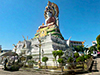
Phra Phutta
Chayantih
Mahamuni
Bophit, a large
Buddha statue in the pahng nahg prok
pose. The statue is positioned on an elevated base
that functions as a small hall. Within this hall are wax effigies of
highly venerated monks, including
of
Somdet
Phra
Yannasangwon,
the 19th
Supreme Patriarch of Thailand (fig.)
and
Somdet
Phra
Maha Muniwong
(fig.).
WATCH VIDEO
and
VIDEO (EN).
回





|