|
|
|
|
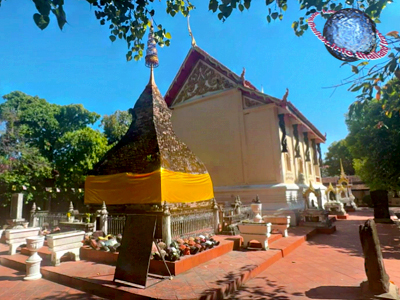
Although the present monastery was formally established
in 1879 AD, archaeological evidence indicates that the
site is significantly older, such as this 200-year-old
Isaan-style
sim
(ubosot)
and several Dvaravati-style sandstone
bai sema. |
|
 |
|
Wat Neua |
|
 |
|
Wat Neua |
|
|
In the back of the
ubosot stands an ancient
Mon–Dvaravati-style
chedi,
distinguished by its square base, tiered superstructure, and
remnants of
stucco
decoration characteristic of early historic religious architecture
on the
Korat
Plateau. |
|
This
chedi is
regarded as one of the oldest surviving religious monuments in
Roi Et
Province and suggests that the area formed part of the broader
Mon–Dvaravati
cultural sphere, which flourished between the 7th and
11th centuries AD.



 |
|
 |
|
Wat Neua |
|





|
|