|
Wat Don Yai (วัดดอนใหญ่)
Thai.
‘Temple of the Large Mound’.
Name of a Buddhist
temple of the
Mahanikaya monastic order located in Lam Luk Ka Subdistrict, Lam Luk Ka District,
Pathum Thani Province,
Thailand. Established in 1910 (BE 2453), the temple was founded on
farmland donated by Luang Yohtha Nareubahn (หลวงโยธานฤบาล) and his
wife
Nang Sa-aht (นางสะอาด), with additional land later offered by
Nang Pheum (นางเพิ่ม). Because of its location along the canal
network, local residents referred to it as Wat Klang Khlong Paet (วัดกลางคลองแปด).
The temple received its royal ordination boundary,
wisung khama sima,
on 4 August 1922 (BE 2465). A distinctive feature of the temple is
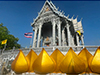
its Silver
Ubosot, an ordination hall built in a
four-gabled
jaturamuk style.
In 2026, the chapel was not yet completed, and
the
look nimit—large,
round, cannonball-like boundary stones used to demarcate the sacred limits of
the consecrated ordination hall—were displayed around the
bot.
Each stone stood beside a small
mondop-like
structure (fig.)
intended to house the
bai sema (fig.)
boundary markers. Inside the ubosot, alongside several wax effigies of revered
monks from the past, stands
the large white
Phra prathaan,
i.e. the principal
Buddha statue, named
Somdet Phra Suwan Pathum Phutthaphotchana
Woraphon (fig.). A
wihaan within the temple houses various revered figures,
including
Ganesha (fig.),
Brahma (fig.),
Thao
Jatukam-Ramathep
(fig.),
Thep Than Jai
(fig.),
Thoranih (fig.),
Phra Siwalih
(fig.),
Phra Upakhut (fig.),
Phra Phutta Chinnarat
(fig.),
and
Ai Khai (fig.). The
grounds also contain memorials to King
Naresuan (fig.),
King
Taksin (fig.), and King
Chulalongkorn
(fig.), as well as a fish pond where visitors may feed fish
as a merit-making activity. Directly opposite the temple lies
Phayanagaraat Nature Park, also known as
Phayanaag
Nature Park of the Four Clans (fig.).
This site features large
naga sculptures, a white
Buddha image in
the Open the World posture,
pahng peut lohk, and a
160-metre-long walkway known as
Saphaan
Kaew
Nagabaat. The park
represents the four
naga clans or lineages,
Phayanaag Sih Trakoon (พญานาค 4
ตระกูล): Wirupakkha (ตระกูลวิรูปักษ์), associated with golden scales
and high status; Erapatha (ตระกูลเอราปถะ), depicted with green
scales and closely linked to human legends; Chappayaputta (ตระกูลฉัพพยาปุตตะ),
portrayed with rainbow-coloured scales and believed to inhabit
hidden realms; and Kanha Gotama (ตระกูลกัณหาโคตะมะ), represented
with dark scales. Together, Wat Don Yai (วัดดอนใหญ่) and the
adjacent park form a religious and cultural landscape reflecting
both Theravada Buddhist worship and enduring naga traditions in Thai
belief.
WATCH VIDEO.
回





|