|
Wat Tham Krabok (วัดถ้ำกระบอก)
Thai.
‘Temple
of the Bamboo Cylinder Cave’.
Name of a Buddhist monastic complex in the
Amphur
Phraphuttabaht of Saraburi
Province. It is a famous, but controversial temple, where
opium
and heroin
addicts are treated for their addiction using a treatment based on herbs
and a
strict regimen, combined with education from the
Dhamma.
The term
krabok denotes
a
bamboo
cylinder or a cut-off hollow section of bamboo resembling a pipe (fig.);
in this context, it is thought to reference the tubular, tunnel-like
form of the cave associated with the site, following a naming
pattern comparable to caves such as
Tham Lod (ถ้ำลอด
-
fig.).
The monastery was founded in 1957 by the Buddhist nun
Mae Chi Mian Paanchan (เมี้ยน
ปานจันทร์), also known as
Luang Pho Yai (ใหญ่),
together with her nephews Chamroon Paanchan (จำรูญ ปานจันทร์) and
Chareen Paanchan (เจริญ ปานจันทร์), both of whom had previously
ordained at Wat Khlong Mao (วัดคลองเหมา) in
Lopburi. Although it
functioned for decades as a major monastic community, it received
formal recognition as a
wat only in 2012, at which time
Wichien Pitiwannoh (วิชิญ ปิติวรรณโณ), or
Luang Pho Wichien,
became its first government-appointed abbot. Wat Tham Krabok is
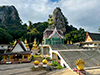
distinguished visually by an ensemble of monumental structures. The
temple’s focal point is an elevated circular platform approached by
a staircase flanked by two giant
Buddha statues, the
left named Phra Nuan Chan (พระนวลจันทร์) and the right Phra Nuan
Phan (พระนวลพรรณ). At the top of the staircase, a seated
Ganesha stands to the
left, while to the right a seated
Buddha holds a
lotus in each hand.
Twenty-five seated
Buddha images in
the
maravichaya posture line the
perimeter of the platform, all facing inward toward an octagonal
base that supports three pillar-like structures symbolising giant
candles. At the centre of this base are four large Buddha statues
seated back-to-back, each flanked by two smaller standing Buddhas.
The statues facing the front and rear perform the
varada
mudra — the ‘granting
of wishes’ gesture — while those on the sides sit in the
meditation pose in front of
a
dhammachakka, the Wheel of
the Law. Nearby, the
ubosot constitutes another
principal feature of the complex and is dramatically encircled by
thirty-six large gilded Buddha statues: twelve on each side in a
variety of upright poses, six along the rear, and five positioned at
the front, plus a sixth centrally placed seated Buddha beneath a
broad parasol-like canopy anchoring the composition. Elsewhere on
the grounds are the quarters historically used to house individuals
undergoing the temple’s strict drug-rehabilitation regimen. In a
park on one side of the temple stands a monumental statue of King
Rama IX, adding a modern
commemorative dimension to the site. The monastery’s international
prominence dates from 1959, when it began its distinctive drug
rehabilitation programme combining Buddhist meditation, induced
vomiting, and ingestion of a proprietary herbal detoxification
potion. More than 100,000 individuals addicted to heroin,
opium,
alcohol, and later methamphetamines have undergone treatment at the
centre. In 1975,
Luang Pho Chamroon, the
first abbot and a former
Police officer, received the
Ramon Magsaysay Award, named after the 7th president of the
Philippines, for his contributions to this humanitarian work.
The programme later drew numerous foreign participants, including
some celebrities, one whose recovery in 2004 received considerable
attention in the British press and led to his long-term residence as
a close disciple of Luang Pho Charoen. The centre has also treated
members of the
Hmong community,
reflecting the longstanding medicinal use of opium among Hmong
populations in the highlands of Thailand and
Laos. From
the late 1970s the monastery assumed an additional role as a
sanctuary for Hmong refugees fleeing persecution in Laos following
the 1975 communist takeover. Many resisted forced repatriation from
other Thai refugee camps and sought safety at Wat Tham Krabok, where
the population grew to approximately 35,000 by the early 1990s. The
temple leadership, particularly Luang Pho Chamroon, offered support
to elements of the Hmong resistance. This political involvement,
along with the large concentration of refugees, drew sustained
attention from humanitarian organisations, governments, journalists,
and scholars. Beginning in 1993, the Centre for Public Policy
Analysis (CPPA) and its executive director conducted repeated
research missions to the monastery and to camps along the Thai–Lao
border, often in cooperation with members of the U.S. Congress and
Lao veterans’ organisations, documenting human rights concerns and
pressures toward forced repatriation. During the 1980s and 1990s,
the fate of the Hmong community at Wat Tham Krabok became the
subject of an international debate. The Thai government, supported
by the United Nations and the U.S. administration, advocated
repatriation to Laos, whereas Hmong organisations, human rights
advocates, and American legislators, opposed such measures. After
prolonged negotiations, more than 15,000 Hmong refugees from the
site were permitted to resettle in the United States between 2004
and 2005, with earlier transfers beginning in 2001. Only a small
number of Hmong families remain at the monastery today. In 2003,
concerns that the site was being used to supply support to Hmong
insurgents in Laos prompted the Thai military to encircle the
settlement with fencing and increase surveillance, measures that
remained in place until the large-scale resettlement alleviated
security concerns. By the end of 2015, Wat Tham Krabok had recorded
110,312 individuals treated through its detoxification programmes,
affirming its status as one of Thailand’s most distinctive centres
of monastic engagement, humanitarian action, and socio-religious
innovation. Also called
Wat Tham Khao Krabok,
Samnak Songtham Krabok (สำนักสงฆ์ถ้ำกระบอก)
and Wat Tham Krabok
Co Inter (วัดถ้ำกระบอกโกอินเตอร์).
WATCH VIDEO
and
VIDEO (EN).
回





|