|
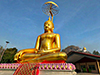
Wat Thap Sila (วัดทัพศิลา)
Thai. ‘Temple of the
Stone Army’ or ‘Temple of the Host of Boulders’. Name of a
small
Theravada
Buddhist
community
temple in
Kanchanaburi
Province. The name evokes the image
of a massed host of stones or an assemblage of boulders, and
reflects the temple’s close relationship with its surrounding
geological landscape, especially its
‘Sacred
Elephant
Boulders’, a group of large
natural rock formations partially embedded in the ground and
sheltered beneath an octagonal-roofed structure within the temple
compound. These stone formations, whose shapes are popularly
perceived as resembling elephants arranged in formation, reinforce
the toponymic concept of a stone army. Known in Thai as
Hin Thep Chang (fig.),
their veneration reflects a broader pattern within Thai religious
landscapes, in which Buddhist practice intersects with vernacular
beliefs, animistic traditions, and the attribution of spiritual
potency to distinctive natural features.
According to a monk at
the temple, the elephant-shaped boulders are believed to embody the
souls of
war elephants that
fell in battle on this
site during Thailand’s past conflicts.
Its architectural layout follows
conventional Thai monastic planning, comprising modest religious
structures and auxiliary pavilions that support communal worship,
merit-making practices, and local ritual life. Due to its location
along the border with
Myanmar,
the temple
has a large community of Mon
people, and
besides the Hin Thep Chang rock
formations, the temple
features
a replica
(fig.)
of the
Golden Rock (fig.),
a renowned Buddhist pilgrimage
site
in
Kyaihtiyo (fig.),
in
Myanmar's
Mon
State,
allowing the Burmese immigrant community to feel somewhat at home.
WATCH VIDEO
and
VIDEO (EN).
回





|