|
Wat Beung Latthiwan (วัดบึงลัฏฐิวัน)
Thai. ‘Marsh Temple at the Young
Sugar Palm Grove’. Name of a public Buddhist temple affiliated with the
Mahanikaya monastic order, located in Tha Luang (ท่าหลวง) Subdistrict, Tha Reua (ท่าเรือ) District,
Phra Nakhon Sri Ayutthaya. The temple occupies an area of 13
rai, 3
ngan
and 90
square
wah. Wat Beung Latthiwan was founded in 1807 but later fell into disuse and became abandoned. In 1957, Siam Cement Public Company Limited acquired land near the former temple to extract soil for cement production, resulting in the construction of a transport road through the temple grounds. Restoration efforts began in 1967, the monastery was revived and named Wat Beung (วัดบึง), a name that later extended to Wat Beung Latthiwan (วัดบึงลัฏฐิวัน), reflecting the abundance of palm trees surrounding the area. In 1975, the Ministry of Education officially recognised it as an active temple with resident monks, and on 8 November 1983 it was granted royal
wisung khama sima. The temple complex features the
Phra Mahathat
Chedi
Sri
Ayutthaya
Sammasam
Photiyaan, a
chedi described as combining architectural elements from Phra Borommathat Chedi, the main
stupa of
Wat Mahathat Wora Maha Wihaan
(fig.) in
Nakhon Sri Thammarat, and
Phra Pathom Chedi (fig.) in
Nakhon Pathom, whereas its pinnacle
is
in Laotian style
(fig.), akin to the distinctive
stupa of
Wat Phrathat Phanom (fig.) in
Nakhon Phanom. Its interior enshrines sacred relics and contains mural paintings. The temple also houses a life-size and highly detailed representation of the
Buddha's
parinirvana, depicting the
reclining Buddha at Salavana Grove in
Kushinara.
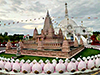
In front of this stupa, a large-scale model of the
Maha Bodhi Pagoda (fig.) in
Bodh Gaya rises from a giant
lotus base, symbolising the site where the
Buddha attained
Enlightenment. Before it stands a statue of Prince
Siddhartha, the
Buddha-to-be, portrayed as a young boy standing upright with his right arm raised and his index finger pointing skyward (fig.). On either side of the entrance, between the lotus platform and the main chedi, stand reddish-brown balustrades depicting the
Churning of the Ocean of Milk. The panel on the left shows the
devas, while the one on the right features the
asuras, each group using the serpent
Ananta
as a stirring rope (fig.). In a field opposite the temple’s entrance stands an unfinished building crowned by a large white
Buddha statue seated in the
dhammachakka pose, poised upon a pinkish-red lotus base.
WATCH VIDEO,
VIDEO (EN)
and
VIDEO (TH).
回





|