|
Wat Wangrih Khiri Wanwanaram (วัดวังรีคีรีวันวนาราม)
Thai. Name of a
Theravada Buddhist temple located in
Chonburi Province, set within a forested and mountainous landscape. The temple represents a monastic complex that integrates natural topography—hills, caves, and elevated viewpoints—into its sacred spatial organisation, reflecting a long-standing Thai Buddhist tradition of situating religious sites within liminal and natural environments. It functions as an active centre for worship, merit-making,
meditation, and popular devotional practice. A distinctive feature of the temple is its emphasis on
naga imagery, including prominent sculptural representations of serpent deities revered as guardians and symbols of protection, fertility, and spiritual authority. The most prominent figure is Poo Phaya Dam Saen Siri Chanthra
Nakathibodih (ปู่พญาดำ แสนสิริจันทรา นาคาธิบดี), represented as a black naga and revered as a sovereign guardian of the site. His name conveys authority and auspicious power: Saen Siri suggests abundance and merit, while Chanthrah associates him with
Chandra, the moon, a common symbol of protection, coolness, and spiritual balance in Southeast Asian belief systems. As a Nakathibodih, lord of nagas, he embodies guardianship over the land and its sacred boundaries. Complementing this figure is Mae Yah Manih Chanthrah Montrawichuramani Narumaht Thewi (แม่ย่ามณีจันทรา มนตราวิชุรามณีนฤมาสเทวี), depicted as a white naga and regarded as a maternal and protective presence. Her elaborate name emphasizes qualities of luminosity, jewel-like purity (mani), and sacred speech or
mantra (montra or
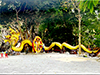
mon), aligning her with themes of blessing, fertility, and spiritual refinement. Together, the black and white naga form a symbolic duality, often interpreted as representing balance between complementary forces such as strength and compassion, protection and nurture, or earthly power and spiritual grace. In contrast to the black and white naga figures, which are each represented with a single hood, the temple also features a monumental golden multi-headed naga positioned beside a large
dhammachakka (Wheel of Law). This sculptural grouping depicts the wheel being pushed forward by Buddhist
monks and a lay devotee, symbolising the collective effort required to advance the
Buddha's teachings in the world. The multi-headed naga, a form traditionally associated with heightened power, vigilance, and cosmic protection, functions here as a guardian of the
dhamma itself, while the
dhammachakka represents the doctrine set in motion through human agency. Together, the figures articulate a visual theology in which naga guardianship, monastic discipline, and lay participation are united in sustaining and propagating the Buddhist moral order. The narratives surrounding these naga figures are not derived from canonical Buddhist texts but belong to the sphere of local religious tradition and contemporary popular devotion. Their prominence at the temple illustrates the enduring role of naga symbolism in Thai
Buddhism, where serpent beings function as liminal guardians connecting the natural landscape—water, caves, and forests—with the moral and spiritual order of the Buddhist world. The temple grounds also include cave shrines, devotional structures associated with the veneration of
Buddhapada, the Buddha’s footprint, and commemorative spaces dedicated to historical figures, notably King
Taksin the Great. At the entrance to the temple is a marked site traditionally identified as an execution ground dating to the
Thonburi period.
WATCH VIDEO.
回





|